Sunday, 26 April 2020

Friday, 1 February 2019
Thursday, 31 January 2019
Thursday, 10 January 2019
My example -- Beautiful Music.
Two versions of the same tune. One is much more famous than the other, and sadly, that famous recording is also inferior to the other one. I bring this up a way to generate knowledge questions about how we value the arts.
Charlie Parker is part of a very small group of jazz musicians who changed music, bringing a completely new way of playing and thinking to the art form. He's in a special class of artists, along with other great innovators. Pablo Picasso may be an apt analogue in the visual arts.
Unlike a visual artist, however, a musician's art is captured in performance. Every time a musician plays on stage or records in the studio, the work on display is the product of a career of study and of daily practice. Predictably these performances vary. That's why musicians make multiple takes of recordings. Even with technology available in the 1950's, it's possible to "correct" mistakes by cutting out a phrase and pasting in a correction.
This technique has been used and overused. In the 1990's, one of the great classical clarinet players published a recording with over a thousand such edits in a twenty minute recording. This recording leads to a knowledge question: To what extent can a recording be altered before the recording is not authentically the artist's work? With modern improvements to recording technology, it's possible to electronically correct a player's intonation and change the timbre of their sound. Are these "doctored" recordings still recordings of the artist, or are they something else? At what point does the music just become a product of the machine? And is that music less "artistic" than something performed live, or performed with minimal editing? In other arts, this issue doesn't come up: Painters correct their mistakes, authors employ proofreaders.
Which brings us back to these two recordings of Charlie Parker playing the song "Loverman." The better version was recorded in 1951. It showcases his strong, full sound, his natural ability to speak through his instrument, his completely fresh and original phrasing, and absolutely virtuoso technique.
The more famous recording, however, was made earlier, in July of 1946. Charlie Parker suffered from drug dependency, and this recording was made when he was experiencing withdrawal symptoms from his heroin addiction. According to most accounts, he was drinking heavily in order to take away the withdrawal pains, and was so drunk while recording that he literally had to be propped up by someone while he was playing. When you listen to this recording, you can still hear some of his virtuosity -- in fact, he uses some similar phrases to the ones that appear in the later recording. His tone, however, is much thinner, and he frequently ends phrases abruptly, as if his air is cut off. His original statement of the melody begins at about measure three. After the recording session he went to his hotel room and lit the curtains on fire, almost burning himself to death. Then he was sent to the Camarillo mental asylum. where he spent the next 8 weeks. It's a recording that ought to have been discarded.
But Charlie Parker didn't have any say in the matter. He was under contract to produce records that would be sold, and so this inferior display of his artistry became part of his recorded body of work. It also became his most famous recording of this particular song. Parker, of course, was very upset that the recording was ever released.
So what value does this recording have? Some say this recording has become so popular because it captures a moment of great human suffering. "It's what pain sounds like," said someone. And whether that's fair to the artist or not, it gives another kind of insight into the human condition.
Monday, 26 November 2018
The Arts -- A Recent Headline-Grabber
 |
| From the New York Times, 13 November 2018 Edward Hopper’s “Chop Suey,” an oil on canvas from 1929, sold for $91.9 million on Tuesday night.Heirs of Josephine Hopper/Licensed by VAGA at Artists Rights Society (ARS), NY; via Christie's |
An interesting question as we discuss the arts in class: What gives art value? This painting, by Edward Hopper, fetched nearly one hundred million dollars at auction. If you read the article, you'll see that not everyone agrees with this value.
Saturday, 27 October 2018
Blogs of the Week -- Ways of Knowing and Logical Fallacies

Melissa Askew found a wonderful way to combine her ideas with the content of a video. She shows this clip (just 2 and a half minutes long) and annotates it with observations of the fallacies as they come along. The descriptions are clear and show excellent command of the terms. Great work!
Follow the link to see how it works!
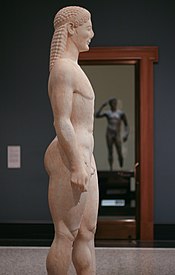
Samyukta Saklani presented a fascinating real-life situation in describing this remarkably realistic ancient Greek Kouros statue. Her post explains how the intuition of many renown scholars led the curators of the Getty Museum to doubt the authenticity of this statue. Since purchasing the Kouros, the Getty has continued to study it, finding more and more reasons to doubt its authenticity, but no definitive proof. Her post demonstrates the value of intuition -- informed by other ways of knowing, of course -- and also provides an interesting account of how art historians and other scholars have treated this object.
Have a look at her blog at this link!

Alissa Thakker took a very popular topic -- US president Donald Trump's logical fallacies -- and presented them in a logical, systematic way. Alissa's post does exactly what all critical listeners and readers need to do all the time: it inspects the claims, compares them to facts, and then evaluates them critically, using the language of logic. Many students worked with the same material, but few have done so as effectively.
Check out her blog at this link!

Read it for yourself at this link!
Thursday, 25 January 2018
Featured Blogs from the Class of 2018

Ishani Khanna applied strong argumentative techniques in her last post, where she discussed the Massai People's indigenous ways of life, how they are changing, and how they apply to Wade Davis's discussion of our planet's shrinking "ethnosphere." She explores the value of Massai medicine as well as other traditions. Previous posts explore issues in religious knowledge and history, and both posts demonstrate facility with the language of the TOK course as well as interest in the situations she brings up. Check it out at this link!

Lily Clurman produced some very interesting work by combining her interest in the arts with other subjects we reviewed. The image on the left is part of a collection of representations of religious sacrifice in the arts. The post shows connections expressions of sacrifice and the way the art reflects or expresses religious thinking in a variety of traditions. Another post investigates how photography as an art form can also become part of the historical record -- and an influencing feature of history itself. You can see her work at this link.
Subscribe to:
Posts (Atom)